Internship Management Software: What It Is and What to Look For
By The Internhuddle Team · Tools · Published · 8 min read
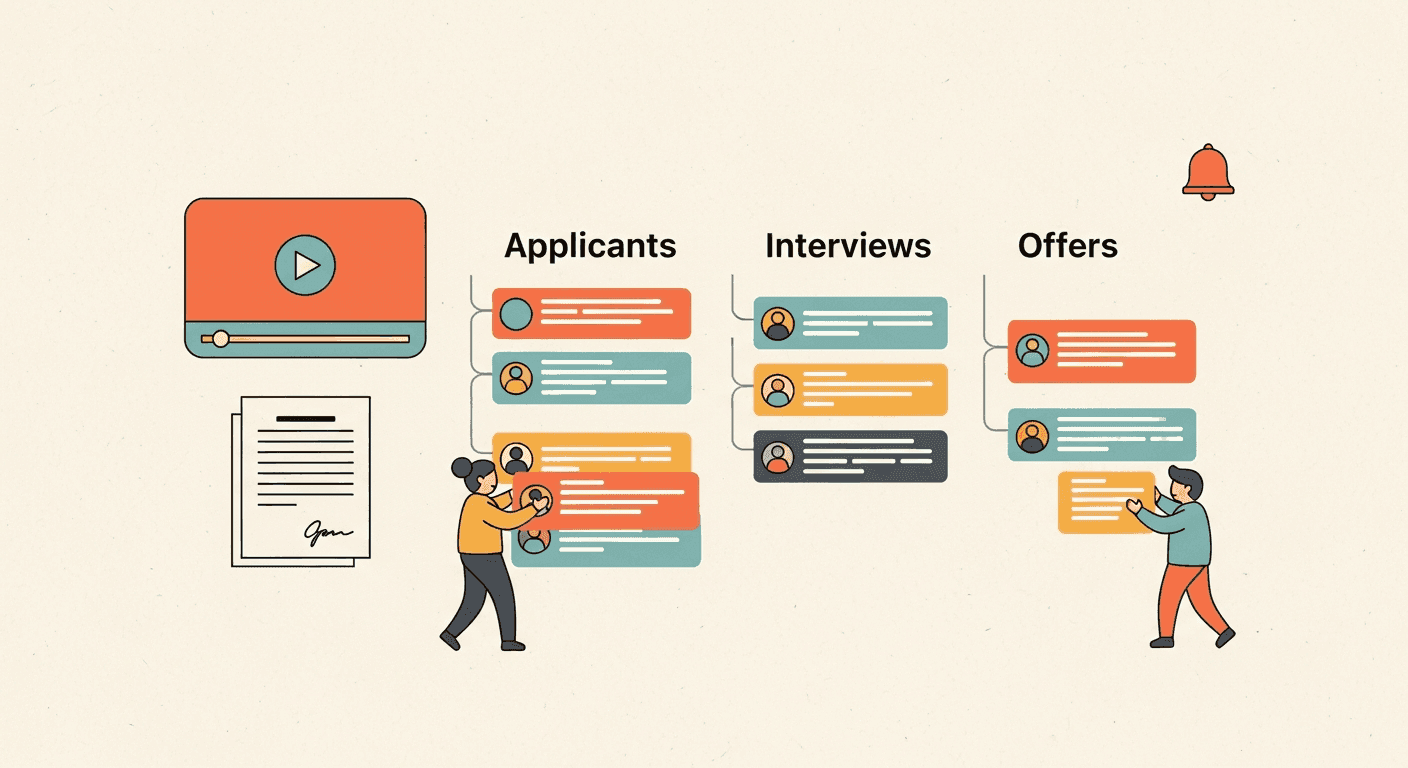
Every internship program starts in a spreadsheet, and every growing one hits the same wall: two hundred applications nobody has time to screen fairly, a feedback cadence that dies in week five, a contract that never came back signed, and a mentor who quietly stopped showing up — discovered in week nine. Internship management software exists because the failure modes of internships are coordination failures, and coordination is what software is for.
Quick answer: internship management software runs the whole lifecycle — structured applications, fair screening, offers and e-sign contracts, onboarding, automated weekly feedback with chase-ups, at-risk alerts, and final reports — in one system. It's worth adopting when application volume or intern count outgrows what a spreadsheet-and-memory system can track, which is earlier than most teams think.
What the spreadsheet stack actually costs
- Screening collapses first. Hundreds of applications and no structure means gut-feel triage — slow, inconsistent, and biased toward polish over evidence.
- Cadences die silently. Weekly feedback depends on humans remembering; by mid-program, remembering loses to everything else. Nobody notices until the exit survey.
- State lives in heads. Who's awaiting an offer? Whose contract is unsigned? Which mentor hasn't submitted feedback in three weeks? In the spreadsheet era, the answer is "ask Sarah", and Sarah is on holiday.
- Nothing compounds. Each cohort starts from scratch because last year's decisions, feedback and outcomes live in a dead spreadsheet nobody reopens.
The six capabilities that matter
- Structured applications and screening support. Same questions for every candidate, video introductions against fixed prompts, and scoring — rubric-based or AI-assisted — that separates role fit from communication polish and shows its reasoning. Auditability is the difference between screening help and a black box.
- Offer-to-contract flow. Offers with deadlines, e-signature contracts, automatic reminders, and expiry handling. The unsigned-contract-on-day-one problem should be extinct.
- Onboarding checklists. HR documents, NDAs, equipment, account access — tracked per intern, chased automatically, visible at a glance.
- The feedback loop, automated. Weekly structured exchanges between mentor and intern, with chase-ups when either side goes quiet and escalation when they stay quiet. This is the feature that most changes outcomes, because cadence-decay is the most universal program failure.
- At-risk detection. Missed check-ins, shrinking reflections, declining scores — surfaced in week four, when intervention is cheap, instead of week ten, when it's an autopsy.
- End-of-program outputs. Performance reports grounded in the actual feedback record, certificates, exit surveys, and a conversion decision backed by twelve weeks of written evidence rather than final-week memory.
Automation with a human override
The useful pattern isn't full autopilot — it's defaults with exceptions. Routine steps (reminders, chase-ups, scheduling, certificate generation) run automatically; judgment steps (offers, rejections, escalations) either queue for human approval or run automatically only where you've explicitly allowed it. Evaluate any tool on how finely you can tune that dial per stage, because the right setting differs: screening scores can run instantly, offer emails probably shouldn't.
Evaluating tools: the questions that separate them
- Does screening show its work? Scores without visible reasoning can't be defended, calibrated, or trusted.
- Does it chase, or just record? A form nobody is reminded to fill is a spreadsheet with better fonts. The value is in the follow-up machinery.
- Does it cover the middle? Many tools do applications well and go silent after the offer. The internship itself — feedback, progress, risk — is where programs actually fail.
- Can interns see their own record? Portals where interns track feedback, milestones and their final report turn the program's paperwork into part of the intern experience.
- What's the pricing shape? Per-seat pricing punishes seasonal programs; usage-based or per-intern models fit the burst pattern of internship cohorts better.
Full disclosure: we build Internhuddle, an internship management platform organised around exactly this lifecycle — structured applications with transparent AI screening, offer and contract flows, automated weekly feedback with at-risk alerts, and evidence-based final reports. The evaluation questions above are the ones we'd want you to ask of any tool, including ours.
When to switch
Three reliable triggers: an application pile you're screening by skim, a feedback cadence that has already died once, or a second cohort starting while the first one's records are scattered across tools. Any one of them means coordination — not intent — is now your program's limiting factor.
Frequently asked questions
What is internship management software?
Software that runs the full internship lifecycle in one place: collecting and screening applications, sending offers and contracts, onboarding, mentor matching, weekly feedback loops, at-risk alerts, and end-of-program reports and certificates. It replaces the typical stack of spreadsheets, email threads, shared drives and memory that internship programs otherwise run on.
Do you need software to manage interns?
Below roughly three interns a year, a disciplined spreadsheet-and-calendar system works. Past that — or with hundreds of applications per posting — manual coordination becomes the program's main failure source: screening turns into gut-feel triage, feedback cadences silently die, and deadlines slip unnoticed. Software earns its keep exactly where human attention runs out: repetition, reminders and record-keeping.
What features should internship management software have?
Six essentials: structured applications with fair screening support (rubrics or AI-assisted scoring you can audit), offer and e-signature contract flows, onboarding checklists, an automated weekly feedback loop with chase-ups, at-risk detection that flags disengagement early, and end-of-program outputs (performance reports, certificates, conversion records). Automation with human override matters more than any single feature.
How is internship software different from an ATS or HRIS?
An ATS stops at 'hired' and an HRIS starts at 'employee #' — the internship itself, which is where programs succeed or fail, falls between them. Internship platforms cover the middle: mentorship cadence, weekly feedback, progress tracking, intern experience, and conversion. If your interns live in the same ATS pipeline as senior hires, nobody is tracking whether the internship is actually working.